Saturday, June 16, 2018

Friday, June 15, 2018. Bunratty Castle and Ballyvaughan.


John put our luggage in the car at 9:38 a.m. and we headed for Adare and then for Bunratty Castle. Adare is rated as the prettiest village in Ireland, with thatched roofs and so on, but it was raining so we just stopped at the Heritage Centre for directions to Bunratty Castle and moved on. Deidre had recommended Bunratty Castle and Folk Village and it did not disappoint us. Just north of Limerick, the castle was built in 1460 and has been well preserved. It has been fully restored with 15th-17th century furnishings. The Bunratty Folk Park provides examples of 19th-century housing for various types of Irish people.

We paid our entrance fee and went to P. McNamara’s Pub for lunch. The pub was full and service was slow. Abby ordered the ham and cheddar sandwich and a bowl of pureed vegetable soup. I had the Irish smoked salmon plate, which consisted of two slices of smoked salmon and a lettuce salad with tomatoes and cucumber.

We headed down hill toward the castle. We passed a couple of curraghs, traditional Irish row boats, turned upside-down to keep them from filling with rain. We stopped at the Loop Head Farm House, the house of a traditional fishing/farming family from West Clare. The family made its living by both fishing and farming, as well as by selling peat cut from the bog. The thatched roof was covered with a grid of ropes to keep it in place during Atlantic gales. The house was made of mortared stone that had been thickly whitewashed. Most of the houses in the folk park were actual buildings that had been moved to the site, which made them even more interesting.

Next was the Cashen fisherman’s house, a two-roomed home of a North Kerry fisherman. The wooden timbers and some of the furniture in this house had been made from wood salvaged from shipwrecks or from flotsam and jetsam. The floor was of rammed earth. Smuggling by fishermen brought in wine and brandy, which were preferred over beer and whiskey among the North Kerry fishermen’s families.

We marched into the castle, where our first stop was the main guard room, the main living room of the common soldiers and retainers. It is the room now used for medieval banquets. There were several elaborately carved cupboards from the 15th and 16th centuries. We climbed up a very narrow, one-way staircase to the Great Hall, the original banquet hall and audience chamber of the Earls of Thomond. The walls were furnished with original tapestries and an oak “dower-cupboard” from 1570. Next door was the kitchen with an enormous fireplace and large turtle shells on the wall that were used as dishes and covers.

We climbed about 20 steps to the Earl’s bedroom, where one of her ladyship’s beaded dresses was laid on the bed. We passed into the North Solar, where the chandelier is a German “leuchterweibchen,” an odd-looking mermaid made of either painted wood or porcelain. Abby went back down to the Great Hall, while I climbed about 40 steps up to the battlements, where there was a nice view of the Ratty River at low tide, with the Shannon estuary in the distance.

We exited the castle and visited the Mountain Farmhouse, a poor farmer’s house of a type found in Limerick and Kerry. Next was the Shannon farmhouse, the first house to be reconstructed in the Folk Park. It originally stood on what is now the main runway of the Shannon airport. We looked into the “Bothan Scoir,” a one-room house of a poor landless laborer who would have worked for a local landlord. Many of these houses and their occupants were lost during the potato famine. The Golden Vale farmhouse was a replica rather than a house moved to the park. This farm would have been about 100 acres with 20 cows, a half-dozen hogs, two horses, a donkey, and many chickens, ducks, turkeys and pigeons. There was quite a contrast between this house and the home of the poor landless laborer.

After leaving the castle and folk park, Deidre had advised us to drive as far as the Kinvarra exit on the motorway, a divided highway, and then approach Gregan’s Castle Hotel near Ballyvaughan from the north, avoiding the dreaded Corkscrew Hill. We would later spend plenty of time on Corkscrew Hill, but with Martina as a driver. Deirdre’s advice was sound, and we arrived at Gregan’s without incident. At the hotel we received a free upgrade to a two-room suite, with a very large bedroom and bathroom and a separate sitting room. Both the bedroom and the sitting room overlooked the Burren, a rocky, glaciated landscape known for its diversity of flora.

We ate dinner in the hotel restaurant beginning at 6:00 p.m. The preparation and presentation of food in the restaurant is amazing; several restaurant awards were posted in the hotel lobby. Dinner started with some snacks, chick liver pate, crispy oysters and smoked salmon with lemon foam on top. The first course was mackerel tartare served in a scallop shell, followed by wild rabbit for me – the best rabbit I have ever had – and crab wrapped in cucumber for Abby. For the main course, I had roast suckling pig while Abby had free-range veal. The food was amazingly good, possibly the best we have ever had.

Dessert was brought to us in front of the Spain-Portugal world cup soccer game, the first half of which we watched with an English couple in the television lounge area associated with our rooms. Abby had a delicious assortment of cheeses, while I had a sweet chocolate-raspberry pave and with a dollop of sorbet. Even more amazingly, Ronaldo, scored a hat trick that left the game with Spain all tied up at 3-3. Our day was almost as good as Ronaldo’s.

Thursday, June 14, 2018

Thursday, June 14, 2018. The Dingle Peninsula.


Deidre collected us at 9:30 a.m. and we set off for the Dingle Peninsula. We drove past Minard Castle, ancestral home to the Fitzgerald family. This castle has not been restored and is not accessible to the public. We stopped at Inch Strand (or Beach) to pick up objects to exchange in our renewal of vows. Because we are approaching our 40th wedding anniversary, Deidre asked us if we wanted to renew our vows at an Ogham Stone in a Kil Macader churchyard, which is a traditional place for doing so. We replied in the affirmative.
We stopped at the Fahan Beehive Huts, which are not in Fodor’s, but which Deidre said were the best beehive huts on the peninsula. They were originally built in 2500 B.C. and included a capstone that could be removed to allow smoke to exit. The huts are corbeled with stones that gradually progress inward, creating a dry interior without the use of mortar. Outside the huts, Deidre picked up a lamb, which Abby petted.

We stopped for view of the Blasket Islands, just off the tip of the Dingle Peninsula. These islands were inhabited until 1953, when a boy died of a treatable disease because the weather was too bad for him to be evacuated to a hospital. After that the government forbade the habitation of the islands. Everyone had to move to the mainland, where medical assistance would be more readily available.

Deidre drove us to Clogher Beach, where we followed a tour bus that was backing down the one-lane road to the beach’s parking area. We hopped out and walked down a steep ramp to a beach that had big wind and big waves rolling in. “No swimming” signs were posted because of the steepness at which the shore recedes from the beach.


We then went Kil Macader church, which dates from the 12th century, and has an Ogham Stone in the graveyard, which is used for renewing wedding vows. Through a hole in the top of the Ogham stone, we touched our thumbs with our ring fingers showing our wedding rings. We exchanged wedding vows and exchanged tokens of our appreciation for each other. Abby gave me a cockle shell that she found on the Inch beach and I gave her a red sandstone rock, red being the color of love or, as Deirdre put it, passion.

We stopped in Anascaul at the South Pole Inn, a pub founded by Tom Crean, who was second in command to Ernest Shackleton during his voyage to the Antarctic in 1914-1917. Mr. Crean enlisted in the British Navy at the age of 15, but had to lie about his age since the minimum enlistment age was 16. He joined Ernest Shackleton’s Imperial Trans-Antarctic Expedition on the Endurance, which became trapped and then crushed in pack ice. The crew escaped to the uninhabited Elephant Island, and a boat was sent 800 miles to a whaling station on South Georgia Island, from which Shackleton mounted a rescue of the men stranded on Elephant Island. Shackleton returned his entire crew with no lives lost. Tom Crean retired to his home town of Anascaul to build and operate a pub called the South Pole Inn. I had a glass of Expedition Ale in honor of Mr. Crean.

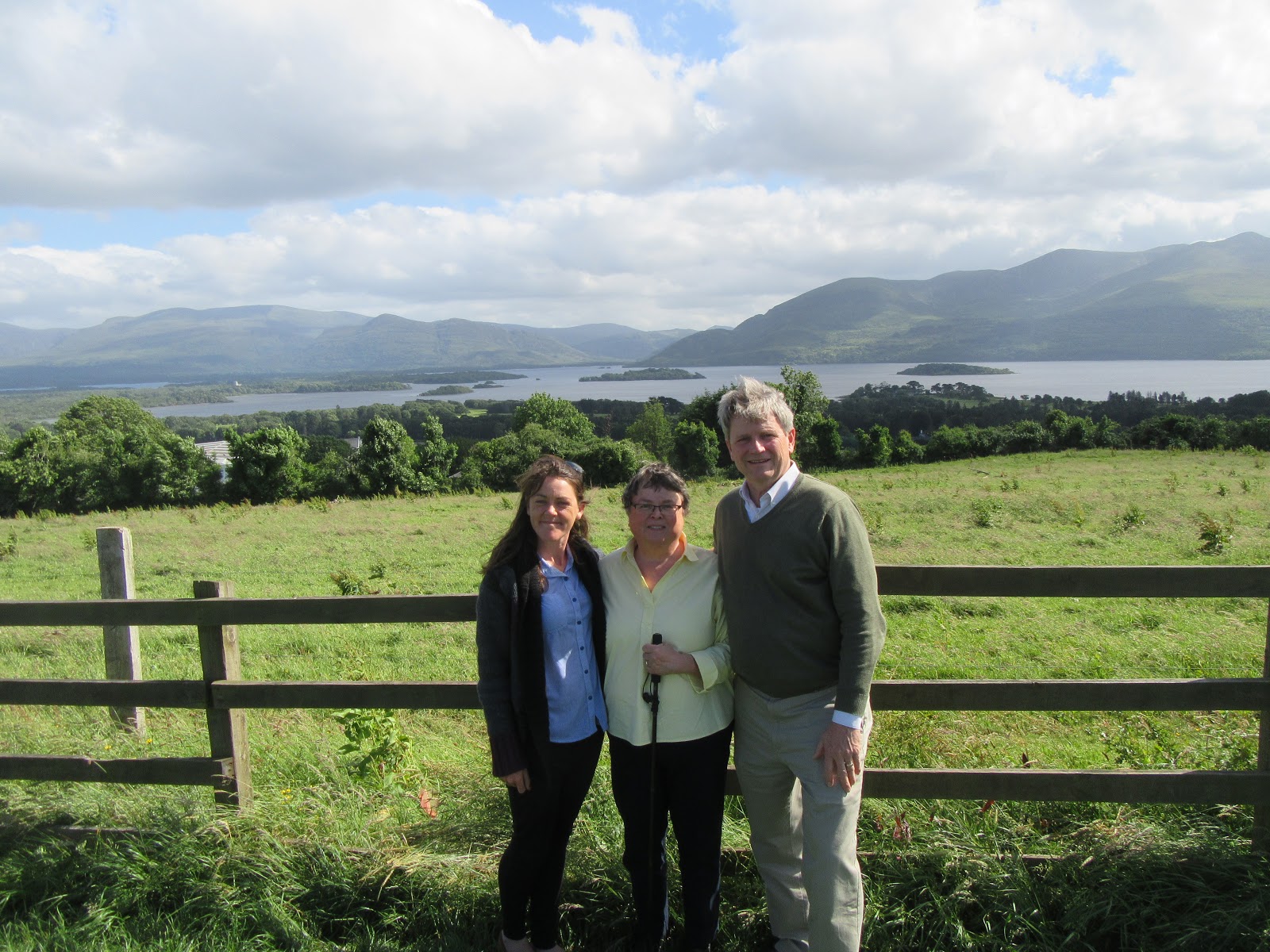
On the way back to Killarney, our last stop was at Aghadoe Heights, where there is a beautiful overlook of Killarney and Lough Leane. Someone with an American accent tinged with Irish took a photo of the three of us overlooking the lake. Deidre was careful to show us how to get out of town toward our next destination, Ballyvaughan. She was such a kind and thoughtful guide that the three of us exchanged hugs and fond goodbyes when she dropped us off at the Killarney Royal Hotel.

Our hotel package entitled us to a lesson in how to pour a pint of Guinness in the hotel bar. The bartender declared that I was a natural, and clearly had previous experience (I had not). Abby, not being a Guinness drinker, was allowed to pour herself an Bulmer’s cider instead. She also proved to be quite adept. We watched the second half of the Russia v. Saudi Arabia world cup soccer game while we sipped our drinks. Russia won 5-0.

We stopped by the Shire, the only pub in Ireland that is themed with Lord of the Rings. I had a Gandalf Ale while Abby drank a local whisky. We walked two blocks to the Porterhouse pub for a supper of fish and chips (me) and beef fajitas (Abby). We retired happily to our hotel after a satisfying day on the Dingle Peninsula.

Wednesday, June 13, 2018. The Ring of Kerry.


We met Deirdre in the lobby at 9:00 a.m. She has brown hair and blue eyes and was wearing a green jacket, a fuchsia shirt and black pants. She shook hands with both of us and introduced herself. Our first stop was to see Brendan, a man about our own age, demonstrate how a pair of Australian sheep dogs could manage a flock of six black-faced sheep. He used a combination of vocal calls and whistled calls to issue orders to the dogs, who followed them eagerly. The flock of sheep were putty in his hands. He then showed us a pen of many varieties of sheep, including one from the Middle East called Jacob’s sheep that had four horns. It was an interesting experience, and Abby got us admitted for half price because we missed the first half of the demonstration.

We passed the ruined childhood home of Daniel O’Connell, a non-violent agitator for equality for Catholics who was active in the early 1800’s. We entered Cahersiveen and drove past a museum devoted to Daniel O’Connell located in a converted military barracks. We drove across a one-lane bridge to Cahergal ring fort. We could see another ring fort, Leacanabuaile, less than a mile away. In the southerly direction were the ruins of Ballycarberry castle, the 15th-century home of the McCarthy clan.

Ring forts date from about 500 B.C. and were the homesteads of just a couple of extended families, who would move their livestock inside the forts at night for protection. Rick Steves reports that these ring were signs of prosperity. This region was more prosperous because it had copper that could be mined and sold to make bronze tools. A daub-and-wattle partition was used to separate the livestock from the humans inside the fort, according to Deidre. The path to the fort was dotted with wild yellow iris and magenta foxglove.

On the way to Port Magee, Deidre stopped her green Mercedes minivan at a peat bog that was being harvested for fuel. The peat is cut out of the ground by using long spades and then is stacked in tripods to dry not so much in the sun, because Ireland does not see much sun, but in the wind, of which there is plenty. She showed us a chunk of dried peat about 15 inches long and four inches square. She also pulled up a handful of sphagnum moss and pointed out the round-leaved sundew plants, carnivorous plants that capture small insects and digest them for nutrients.


We then crossed the bridge from Port Magee to Valentia Island to see if the Skellig Islands were visible in the rain and mist. We stopped at a monument to the first trans-Atlantic cable, which was actually the fourth attempt, in 1866. The second attempt, in 1858, had worked for three weeks and then had burned out because of over-voltage. This is the westernmost part of Europe and was deemed to be the best spot to land a communications cable on the European side.  The other end was in Newfoundland. A final cable was laid in 1894 and was used until the advent of satellite communications in 1965.
We could just barely see the Skellig Islands in the distance through the rain and mist. A boat taking passengers to the islands was battling high winds and waves to get there. Deirdre said that, if we wanted to go to the Skelligs, our boat trip had to be booked a year in advance. We did not go. The Star Wars movie that used the Skellig monastery as one of its sets had really popularized the islands.

In Waterville we stopped at the Lobster Bar and ordered lunch at the carvery. I had the seafood pie, similar to a shepherd’s pie but with seafood rather than ground beef, while Abby had creamed chicken and Deirdre had seafood chowder. We shared a bowl of olives and dried tomatoes. Charlie Chaplin liked to spend his summers in Waterville, and there is a statue of him next to the highway. Just outside of town is the Eightercua stone row, a row of four standing stones that the landowner does not allow access to. However, they are visible from the road and I was able to take some pictures of them after Deidre pulled the car over to the side.


We passed a ring fort, barely visible in the mist, and Abbey Island, with its excellent sand beach. Deirdre reported that, even in mid-summer, the water temperature would only be 40 degrees, which is a bit cold for swimming, although it is done on sunny days. We stopped at Moll’s gap where Abby had a Diet Coke and I had a chocolate-hazelnut torte with whipped cream. A woman was operating a hand loom in the shop, and I bought an Irish woolen garment and a postcard as souvenirs. 

Moving on, we stopped at Ladies’ View, which gets its na On the way back from the waterfall, Deidre pointed out a holly tree, a species that does not grow in Minnesota because of the harsh winters, but appears to thrive in Ireland.
me from Queen Victoria’s ladies-in-waiting who expressed pleasure at the view during the queen’s visit in 1861. Our final stop on the Ring of Kerry was Torc Waterfall where Deirdre took some pictures of us, first in front of a rapids and then in front of the waterfall itself. The waterfall gets its name from a wild boar that Finn McCool slew near this spot – “toirc” is the Irish word for boar.

We ate supper in the hotel bistro, where Abby and I both had the confit of duck. Abby’s appetizer was goat cheese while mine was fried brie, both of them coated in panko. The hotel had one man who was serving many roles – concierge, waiter, bellman, etc. At our previous hotels there would have been two or three people doing his job. He was very busy, but nonetheless provided good service.

Wednesday, June 13, 2018

Tuesday, June 12, 2018. The Drombeg Stone Circle and Bantry House


At breakfast I once again had the “full Irish” – sausage, bacon, black and white pudding, mushrooms and eggs, while Abby had eggs Benedict with spinach instead of ham. We jumped into the VW and headed southwest toward the Drombeg Stone Circle, which is not mentioned in Fodor’s but is described on line as the most beautiful stone circle in all of Ireland. A human burial in the middle of the circle has been dated to about 1000 B.C., but the circle itself could be older than that. Like Stonehenge, the entrance to the circle of standing stones is aligned with the setting sun at the time of the winter solstice. In this case, the entrance is defined by two portal stones that are taller than the others.


Also at the site are the remains of a couple of stone huts and a trough for cooking. The trough would have been filled with water and then hot rocks from a nearby fire would have been rolled into it to bring it to a boil. It was amazing to be at a site that was used for cooking and religious ceremonies at least three thousand years ago.

Most surprising to me were the modern offerings of coins, flowers, small stones and paper/cardboard objects that were left on a flat rock in the middle of the stone circle. The cardboard objects looked like cards from a Dungeons and Dragons-type game that involved druids. I find Christianity to be ancient and mysterious; to see that people attempt to follow even older druidic religions involving circles of standing stones was amazing to me. The site, as in ancient times, was beautiful, overlooking freshly mown hayfields divided by stone walls with the Irish Sea in the distance.

We hiked past fuchsia hedges back to the car and then pushed on to Bantry, where we had lunch in the city center at O’Connor’s Seafood Restaurant. Abby enjoyed an open-faced crab salad sandwich on homemade brown soda bread, while I ate a delicious pan-seared hake with a basil-bread-crumb topping. Mashed potatoes, carrots and cooked red cabbage with a vinegar dressing came on a separate plate and were referred to collectively as “vedge.” Abby was served a mushroom-thyme soup that had too much thyme in it for my taste.

After lunch we drove back to the Bantry House and Gardens, which we had passed on the way into town. One of the best features of Bantry House is the view, overlooking Bantry Bay and its islands. The Earls and Countesses had beautiful views from their second-floor bedrooms. Our guide told us that they owned everything they could see, which was quite a bit - many square miles. The current family lives on the third floor and are no longer nobility, because Ireland is a republic. They support themselves by selling tickets to tourists who wish to see the house and by operating a bed and breakfast. Their real estate holding is down to 100 acres. 


Fodor’s lists Bantry House as one of the top four stately houses in Ireland, because of its beautiful view overlooking the bay, and because of its extensive collection of art, tapestries and fine French furniture. Our guide told us that the family had considered selling some of the artifacts to make money, but the Irish government would not allow them to leave the country, so the proposed auction never took place. From our point of view, it was better to have the house as a private museum, complete with its collection of Aubusson tapestries, state portraits of George III and Queen Charlotte, and furniture that belonged to Marie Antoinette.

From Bantry we drove mostly north through Glengarriff, Kenmare, Moll’s Gap, and the Killarney National Park to Killarney. We were following written directions to the Killarney Royal Hotel, because my cell phone does not have service in Ireland and therefore I do not have GPS except when using hotel wifi. After driving all the way to the other side of Killarney, we stopped at a filling station and asked for directions. One of the patrons gave me directions, which we followed until we felt lost again. I parked the car illegally and got out to ask for more directions, and found that I was looking right at the Killarney Royal Hotel’s sign on the side of its building. What a welcome sight!


After checking in, we walked less than a block to Lord Kenmare’s restaurant for supper. This time Abby enjoyed the hake and I ordered rump of lamb, which was every bit as good as lamb chops. The server encouraged me not to order it any more cooked than medium, and I informed her that I preferred medium rare. It was delicious, and Abby reported that the hake was as well.

Even though we had to stop once to ask directions, we felt much more successful about finding the hotel in Killarney than we did in Cork. We retired feeling satisfied with our day as tourists as well as navigators without GPS.

Tuesday, June 12, 2018

Monday, June 11, 2018. Glendalough Abby and the Rock of Cashel


At 10:00 we asked the concierge at the Fitzwilliam Hotel to bring our rental car around to the front door. Our luggage was loaded and we drove toward Glendalough, site of a monastery, now in ruins, founded by St. Kevin in the sixth century. The gateway is the only surviving entrance to a medieval monastic site anywhere in Ireland, according to Fodor’s. The site is very peaceful, nestled in a valley in the Wicklow Mountains next to two lakes.


A pretty stream ran between the visitors center and the site itself. We took a selfie in front of St. Kevin’s cross. It’s impossible to know whether the saint actually had anything to do with the cross, but it’s his cross now, anyway. Fodor’s has this to say about Glendalough, “A monastery founded by a hermit in the 6th century, attacked by Vikings in the 10th century, and plundered by the English in the 12th century – your typical Irish ruins.”


The most intact building on the site is the six-story round tower. Its door is 11 feet off the ground, so the tower served two purposes. Someone could keep watch at the top of the tower, looking for approaching invaders or marauders, whether they be Viking or English. Once the enemy was spotted, the monks could flee to the tower and pull the 11-foot ladder in after them. At that point the other buildings might be looted, but the monks at least would be safe. Unfortunately the wooden floors inside the tower have all rotted away, and the ladder has, too, so there was no going inside the tower.

Back in the rented VW Passat, we drove over the Wicklow Mountains toward Cashel. The views were excellent, but I had to keep my eyes glued to the narrow, winding road to keep from running into other cars or scraping the stone walls that served as guard rails. We stopped in Hollywood for a lunch of sausage and chips (Abby) and a club sandwich (me). I told the waitress that I had never been to Hollywood before. When we said we were from the United States, she said that our accents gave it away. As we left the restaurant at 2:00, the road was lined with cars driven by mothers and grandmothers who were picking kids up from the school next door.

The Rock of Cashel can be seen from miles outside the city. It is both a defensive fortification on a hill and the site of St. Patrick’s cathedral, now in ruins. Cashel was also the seat of the kings of Munster until 1101. Curiously, many of the kings of Munster were also bishops of the Cashel diocese. Cashel is the spot where St. Patrick, in the fifth century, plucked a shamrock and used it to explain the trinity. I wish I had been there, because I still find the trinity hard to understand. A couple of nice ladies from Texas took my picture in front of St. Patrick’s cross, which has been moved inside to protect it from the weather. The cross rests on the original coronation stone of the kings of Munster.


Since our hotel in Cork was just 60 miles from Cashel, we expected to get there in about an hour. Unfortunately, my GPS was not working since AT&T apparently does not serve Ireland, and the directions provided by our travel agent were difficult for a couple of Americans to understand. After an additional hour or so of wandering around Cork, we finally came upon the Hayfield Manor Hotel. Let’s just say it is not on the beaten track. This was not the first time we would wander around a city looking for a hotel.

Once we were there, the hotel was delightful. Clare at the front desk, when she heard about our difficulty in finding the place, offered us a whisky liqueur made in Cork. Our room was enormous; the bathroom alone was bigger than some hotel rooms. The food in the “casual” restaurant was outstanding – Abby had the rack of lamb while I had the sea bass. The couple dining next to us had a 15-month-old baby who was captivated by his mom’s iPad. I wish we had had iPads when our kids were that age!

Sunday, June 10, 2018. The Book of Kells and the Merry Ploughboys


After a full Irish breakfast, including black pudding, we met Sean Patrick O’Rourke in the hotel lobby for a walking tour of Dublin city center. We walked past the Royal College of Surgeons, a stone building that the rebels had retreated to during the Easter Rebellion in 1916. Sean told us that the rebellion had been led by teachers and poets who had first taken up an exposed position in the middle of St. Stephen’s Green. The British Army then mounted a machine gun on top of the Shelbourne Hotel and drove the rebels into the College of Surgeons. Bullet holes still dot the stone façade of the building. After six days, the rebellion ended and most of the leaders were executed.

Sean then led us down Merrion Street and into Merrion Square where we stopped at the Oscar Wilde memorial. Oscar was portrayed in a smoking jacket with a sardonic expression on his face. The green and pink colors of the smoking jacket and the grey of his pants come from natural rocks of that color. A nude sculpture of his pregnant wife and another, more abstract, sculpture of an anonymous man were part of the display.

We strolled to the west on Clare Street, Leinster Street, Nassau Street and Suffolk Street to the Molly Malone statue. Trinity College and the entrance to the Book of Kells were on our right. We paused in front of the Molly Malone statue at the corner of St. Andrew Street and Suffolk Street. Molly is known for selling cockles and mussels from her wheelbarrow while crying “Alive, alive-oh!” Later in the day, we would hear the Merry Ploughboys sing the well-known song about her. Molly was portrayed in a low-cut bodice, above which the bronze had been shined by admiring hands.


We marched to Dublin Castle, of which all that remains is a round tower. The original castle was built by King John between 1208 and 1220. The rest of the castle has been replaced by 18th-century office buildings that now are used for the presidency of the European Union once every seven years when it is the Irish prime minister’s turn to fulfill that role. Next door are the castle gardens, a park below which lies the original “black pool” that gives the city its name in Irish, Dubh Linn.

After we walked to St. Patrick’s cathedral, the largest cathedral in the country, which is Anglican rather than Catholic, we confided to Sean that we were ready to end the tour. We said good-bye to Sean and took a taxi to O’Neill’s pub where we were directed to the carvery, a buffet line where we could order lunch. I had steamed salmon and fennel with a side of “turnip” (rutabaga to Americans) and broccoli. Abby had roast pork with a side of chopped, steamed cabbage and au gratin potatoes. We drank Falling Apple cider and Guinness. No one in that pub was drinking water with their lunch.

After lunch, it was a short walk to Trinity College, where we had a 2:00 appointment with the Book of Kells, regarded as the greatest national treasure in all of Ireland. The Book of Kells is an illustrated set of the gospels, written on vellum in the 9th century. Two of the four volumes were displayed, one of which contained the common genealogy of David and Jesus from the gospel according to Luke, with illustrations of each of the ancestors. After studying the Book of Kells, we proceeded up a flight of stairs to the Long Library, the home of many dusty-looking books and some marble busts of famous Trinitarians. A display of an early Irish harp caught my attention. It is said to be the harp of Brian Boru, which is deemed unlikely, but more definitely constitutes the model for the Irish harp that symbolizes Guinness stout and lager.

We quickly found a taxi to take us back to the Fitzwilliam Hotel, where Abby took a nap while I ran a few errands and worked on my blog. At 6:10 p.m. we headed over to the Shelbourne hotel for our rendezvous with the taxi that would take us to the Merry Ploughboys pub for an evening of Irish food and music. We rode with a mother in her 80’s from Surry, England, and her three adult children.

The Merry Ploughboys is the only musician-owned pub in Ireland. We were served supper, which in my case consisted of seafood chowder with braised lamb shank and vegetables. Abby had the poached trout with mashed potatoes and vegetables. Apple pie with a shortbread crust was served for dessert. Music was provided by at first three and then four musicians playing a fiddle, an acoustic guitar, and a bass guitar. Tom, the oldest musician, played an Irish pipe and uilleann bagpipes. The fiddler had a fine tenor voice, which nicely accompanied the baritone voices of the other band members. The middle of the two-hour show featured Irish dancers, three women and two men, whom the musicians referred to as boys and girls. On the way back to the hotel our cab driver said that the taller of the two men was the number one Irish dancer in the world. It was a great show, lasting from 8:00 until 10:00 p.m., and the food was good, too.


Sunday, June 10, 2018

Saturday, June 9, 2018. Dublin.


We landed in Dublin at 8:55 a.m. after a 5-1/2 hour flight from Boston. I had slept for only two hours and Abby for just slightly more. The Delta employees were all wearing new uniforms that had just been issued on May 29. Purple was the color of choice for many of the women. Several flights landed in Dublin at close to the same time and we stood in line for an hour and fifteen minutes before clearing immigration.

The weather was fine with a blue sky and the temperature in the upper 60’s. It would not get above 71 all day. Our taxi driver was really enjoying the weather, and said it had been like this for three weeks. We hoped it would continue, but we knew it wouldn’t. This is Ireland, after all.

After checking into the Fitzwilliam Hotel, we walked the four blocks to the National Museum of Archeology, just south of Leinster House, the home of Ireland’s parliament. According to Fodor’s this museum houses the largest collection of Celtic antiquities in the world, dating back to 7000 B.C. We at lunch in the museum café, where Abby had a Caesar salad and I had a beef and Guinness pie.

We enjoyed the beautiful exhibition of Irish gold artifacts dating from 2200 to 500 B.C. I especially liked the gold lunulae, maybe because I had never seen them before and they are very old, from 2000 B.C. Lunulae are flat crescent-shaped sheets of gold. (“Lunula” means “small moon” in Latin.) Only 100 lunulae have been found in western Europe, and 80 of those were found in Ireland. Lunulae were originally developed in Ireland and then exported to other parts of Europe.

I also like the gold torcs, which are relatively newer, dating from about 1100 B.C., and the gold collars or gorgets, which date from 800-700 B.C. These are found throughout Europe and are not as distinctively Irish as the lunulae.


Moving on to the treasury, we were greeted by the odd sight of a three-faced stone head from County Cavan, broadly dated as Iron Age. A couple of ornamented silver chalices from the 8th and 9th centuries A.D. seemed to be quintessentially Irish. Also interesting were the gold and silver brooches dating from the 9th century A.D.

We walked back to the Fitzwilliam Hotel, where Abby took a nap while I took a taxi to the Kilmainham Gaol. Abby had originally planned to go to Kilmainham with me, but she was just too tired. The jail was built in 1796 and finally shut down in 1924. In 1960 former prisoners started restoring it and it now is a museum run by the Irish government. The jail held common criminals, including men, women and children. Our guide said that a child as young as 5 was held there. The jail included a courtroom as well as Catholic and Protestant Chapels.

Political prisoners have made the jail most famous. Fourteen of the leaders of the 1916 Easter Rebellion were held in the jail and executed there by firing squad. Our guide said that the rebellion was not very popular among average Dubliners because some of them were killed by crossfire and city life was greatly disrupted. However, the British government created martyrs by executing them and made the rebellion popular. The Irish revolution started up again in 1919 and ultimately led to independence in 1922. One of the martyrs, Thomas Clarke, bears the same last name as my Irish forebears who earlier had immigrated to Canada after the potato famine.


I taxied back to the hotel in time for our 6:00 dinner reservation at the Inn on the Green Bar at the hotel. We ate olives, mussels and bread while sampling some of the local beverages. After supper we sat on the balcony of our hotel room and listened to the sea gulls. I was sound asleep by 8:15 p.m., well before Abby, and slept for eleven hours.